- Mar 8
SiteGuru - Deep Dive Review
- James Pratt | Founder & CEO
- AI Tool Reviews (AppSumo)
Want to know where to start with AI?
Get a clear first map before choosing tools, training, or implementation.
The Practical AI Snapshot helps identify safe opportunities, areas that need care, and the first practical priorities.
You leave with a short report and a recommended next step.
Review #3 | JamesPratt.com Deep Dive Series
Author: James Pratt | Founder & CEO
Published: 09 March 2026
—
Disclosure & Scope
AFFILIATE DISCLOSURE: This post contains affiliate links and may reference tools the author uses or recommends. If you purchase through these links, a commission may be earned at no extra cost to you. Only tools that are genuinely useful for building sustainable, values-led businesses are shared. This review is independent analysis based on platform documentation, user feedback, and hands-on evaluation.
REVIEW SCOPE: This review reflects SiteGuru's state at time of writing (09 March 2026). Features, pricing, integrations, and deals such as the AppSumo lifetime offer change frequently. Treat all numbers as indicative only and verify current details on the vendor's website and AppSumo page before purchasing.
—
Executive Summary
Key Verdict: BUY - SiteGuru is one of the most mature, well-reviewed SEO audit tools available on AppSumo. For time-poor founders and agencies who need a prioritised to-do list rather than raw data, it delivers genuine value with minimal friction.
Best for: Founders, marketers, and web design agencies running 1–5 websites who want clear, weekly SEO tasks without needing to become an SEO specialist. Agencies managing client SEO will benefit from white-label reports and unlimited user seats.
Not for: Enterprise teams with 10,000+ page sites (the AppSumo page limit caps at 500 pages per code). Teams requiring deep backlink analysis, keyword research databases, or competitive intelligence at the level of Ahrefs or Semrush should look elsewhere.
Biggest benefit: SiteGuru transforms complex SEO audit data into a prioritised to-do list, split cleanly into technical and content tasks. Users consistently report it saves hours per week compared to manually reviewing Google Search Console and spreadsheets.
Biggest risk: The 500-page-per-code limit on the AppSumo deal means larger sites require multiple codes, and the tool lacks the depth of full-suite SEO platforms for backlink building or keyword research.
Setup friction: Low. No installation required. Enter a URL, connect Google Search Console and Google Analytics, and the first crawl begins immediately. Most users report being operational within 15 minutes.
Recommendation: Proceed with a single code ($79). Run a full audit on your primary website, action the top 5 to-do items in Week 1, and measure bounce rate and indexation improvements before stacking additional codes.
—
What It Does (Plain Language)
Most website owners know SEO matters, but they do not know where to start. SiteGuru crawls your website, checks pages for technical and content-related issues, and presents findings as a prioritised action list – not a wall of data.
Core use cases
Technical SEO audit: broken links, canonical issues, sitemap and robots signals, indexability checks, and other technical hygiene items.
Content SEO audit: missing or duplicate titles/descriptions, missing image alt text, thin pages, and internal linking gaps.
Search Console insights: surfaces opportunities using your Google Search Console data (for example, pages with impressions but low clicks).
Ongoing monitoring: recurring crawls and reporting to keep SEO improvements from becoming a one-off project.
Client reporting: exportable reports may support agency delivery (confirm exact formats and white-label options on the AppSumo listing).
Who built it
SiteGuru was created by Rick van Haasteren, a developer turned SEO consultant based in the Netherlands. The company was founded in May 2022 (AppSumo listing date), though Rick has been building and iterating on the product for approximately eight years. The team is currently three people - small, bootstrapped, and established.
Key stats (at time of writing, 09 March 2026)
AppSumo rating: 4.9 out of 5 from 517 reviews
Active users: 4,500 per month (vendor-claimed)
Capterra: 171 reviews
G2: Awarded for ease of use and user-friendliness
AppSumo Select badge awarded
—
Architecture & How It Works
SiteGuru is a cloud-based, crawl-driven SEO audit platform. You enter your website URL and SiteGuru’s crawler scans your pages for technical and content issues.
The crawl pipeline
The verification process works in stages:
Crawl initiation: SiteGuru's server-side crawler visits every discoverable page on your site, following internal links and your sitemap.
Technical analysis: Each page is assessed for indexability, canonical tags, page speed (Core Web Vitals), structured data, hreflang configuration, broken links, and robots.txt compliance.
Content analysis: Metadata (titles, descriptions), heading structure, image alt text, content length, and internal linking patterns are evaluated.
GSC/GA enrichment: If Google Search Console and/or Google Analytics are connected (via read-only Google OAuth), SiteGuru enriches the audit with real keyword data, click-through rates, traffic sources, and ranking positions.
Prioritisation: Issues are ranked by impact and presented as separate technical and content to-do lists.
Infrastructure and data handling
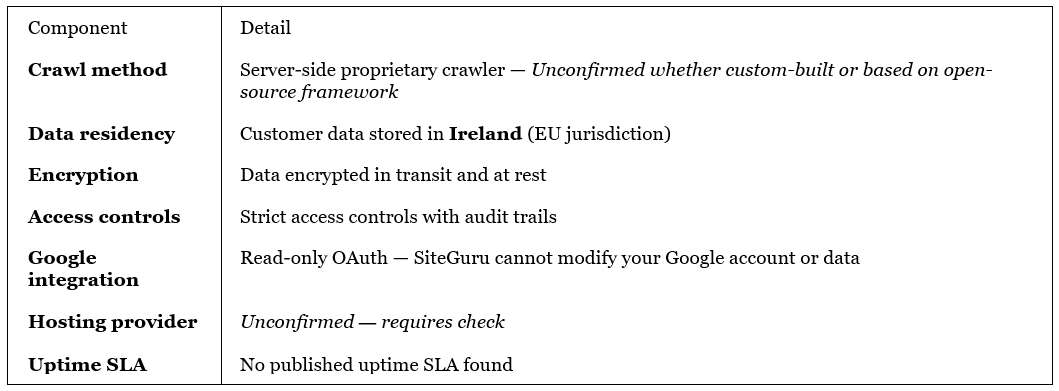
Key dependencies
SiteGuru's audit features work independently of any third-party service - the crawler can scan any publicly accessible website without Google accounts connected. However, the keyword insights, low-hanging fruit identification, AI Visibility Report, and Traffic Acquisition report all depend on Google Search Console and/or Google Analytics being connected.
Single points of failure
The primary dependency risk is Google OAuth. If Google changes its API terms, rate-limits, or deprecates access, SiteGuru's keyword and traffic features would be affected. The core audit functionality (crawl-based) would remain operational. The three-person team is also a concentration risk: key-person dependency is material for a bootstrapped startup of this size.
—
Feature Set Evaluation
Strengths: What Works
Prioritised SEO to-do list. This is SiteGuru's defining feature. Rather than delivering a spreadsheet of 500 errors, it ranks issues by impact and tells you what to fix first. Users on G2 cite "time-saving" (29 mentions) and "actionable insights" (21 mentions) as the most valued attributes. For founders who are not SEO specialists, this removes the paralysis of "where do I even start?"
Clear separation of technical and content SEO. SiteGuru splits findings into two distinct to-do lists. This is uncommon - most audit tools dump everything into a single report. The separation means a developer can work on technical fixes while a content writer handles metadata and headings independently.
Low-hanging fruit and missed clicks reports. By connecting Google Search Console, SiteGuru identifies pages ranking in positions 5–20 with decent impressions but low clicks. It then recommends specific title and meta description changes to capture those missed opportunities. This is one of the fastest paths to measurable traffic gains without creating new content.
Google Update impact tracker. A dedicated report lets you select a specific Google Core Update and instantly compare your traffic before and after. No manual GSC filtering required. For agencies, this is a powerful diagnostic tool during client calls.
White-label, exportable reports. All plans (including AppSumo) include Word, CSV, and HTML report exports with customisable branding. Agencies can deliver client-ready reports directly from SiteGuru without reformatting.
AI Visibility Report (new). SiteGuru now tracks what share of your traffic comes from AI tools (ChatGPT, Perplexity, Gemini, Copilot) and how that changes over time. Requires Google Analytics connected. This is an emerging differentiator as AI search grows.
Weaknesses: Critical Gaps
500-page limit per code on AppSumo. Each $79 code covers one website with up to 500 crawled pages. A 2,000-page e-commerce site requires four codes ($316). The regular plan supports 5,000 pages per site - a significant gap between the lifetime deal and standard pricing. Workaround: Stack codes strategically. The flexible stacking system (minimum 500 pages per slot) means you can allocate pages across sites as needed.
No keyword research database. SiteGuru does not include its own keyword research tool. All keyword data comes from Google Search Console, meaning you can only see keywords you already rank for - not discover new ones. Workaround: Pair with a free tool like Google Keyword Planner, Ubersuggest (limited free tier), or a dedicated keyword research platform.
No WordPress plugin or direct CMS integration. SiteGuru operates entirely as a cloud platform. There is no WordPress plugin, Shopify app, or direct CMS connector. Fixes identified by SiteGuru must be implemented manually in your CMS. Workaround: Use the to-do list as a briefing document for your developer or content team.
Limited backlink capability. SiteGuru offers backlink monitoring but not backlink building, prospecting, or competitor backlink analysis. If link-building is a priority, a supplementary tool is required. Workaround: Use Ahrefs, Semrush, or a free tool like Moz Link Explorer for backlink strategy.
Crawl speed not user-controllable. Some users report 429 ("Too many requests") errors on sites with aggressive server-side rate limiting. SiteGuru does not offer crawl speed throttling. Impact: Sites with strict rate limiting may experience incomplete crawls. Workaround: Contact SiteGuru support to discuss crawl scheduling, or whitelist SiteGuru's crawler user-agent.
—
Use Cases
Micro-business: Solo consultant with a services website (1–5 people, $50k–$300k)
A solo consultant running a 50-page WordPress site connects SiteGuru, runs the first crawl, and discovers 12 pages with missing meta descriptions, 3 broken internal links, and 4 pages with duplicate title tags. The prioritised to-do list lets them fix the highest-impact items in under two hours. Over the following month, weekly emails surface new issues as content is added. Expected outcome: Bounce rate reduction of 5–15% from fixing broken links and metadata; measurable improvement in GSC click-through rates from rewritten titles and descriptions. Total investment: $79 one-time.
SME: 10-person SaaS company with a content marketing programme (2–20 staff, $300k–$3M)
A SaaS company with a 1,200-page website (blog, documentation, product pages) purchases 3 codes ($237) for 1,500 pages. The marketing lead uses the content to-do list to brief the writing team on metadata improvements. The developer uses the technical to-do list to fix indexation and page speed issues. The Google Update impact tracker provides a monthly report to the leadership team. Expected outcome: Consistent weekly SEO improvements without hiring a specialist; clear audit trail of what was fixed and when; reduced reliance on expensive agency retainers for basic on-page work.
Agency: SEO services provider managing 10+ client sites
An agency offering SEO as a service purchases 10 codes ($790 one-time, via stacking) and allocates them across client sites. Each client receives a customised, white-label weekly report generated directly from SiteGuru. The to-do list becomes the agency's deliverable - a clear, prioritised action plan the client can understand without SEO expertise. Expected outcome: Reduced report preparation time (hours saved per client per month); professional, branded deliverables; a scalable system for onboarding new clients without increasing headcount.
—
Implementation Plan
First 60 Minutes
Create a SiteGuru account via AppSumo redemption.
Add your primary website by entering the URL. No DNS changes or code installation required.
Connect Google Search Console via read-only Google OAuth. This unlocks keyword insights, low-hanging fruit, and click-through rate data.
Connect Google Analytics (optional but recommended). This enables the AI Visibility Report and Traffic Acquisition report.
Wait for the first crawl to complete. Depending on site size, this typically takes 5–30 minutes.
Review the prioritised to-do list. Focus on the top 5 highest-impact items in both the technical and content lists.
Fix one quick win immediately - for example, adding a missing meta description to your most-trafficked page.
Export a baseline report (Word or CSV) to document your starting position for future comparison.
First 7 Days
What to test and measure
Confirm that the crawl captured all expected pages (compare SiteGuru's page count against your sitemap)
Check keyword data accuracy by cross-referencing 5–10 keywords against your Google Search Console directly
Implement the top 5 to-do list items and monitor GSC for impressions and click changes
Test the Google Update impact tracker by selecting a recent core update
Red flags to watch for
Crawl returning significantly fewer pages than your sitemap (may indicate crawl access issues)
429 errors in the crawl log - User-reported
Keyword ranking data that does not match GSC (some variance reported) - User-reported
Decision point (end of Week 1): Does SiteGuru's to-do list surface issues you were not already aware of? Are the prioritisation recommendations sensible? If yes, commit to weekly action cycles. If the crawl is incomplete or the data is unreliable for your site, use the 60-day refund guarantee.
—
Pricing & Commercial Model
AppSumo Lifetime Deal (at time of writing, 09 March 2026)
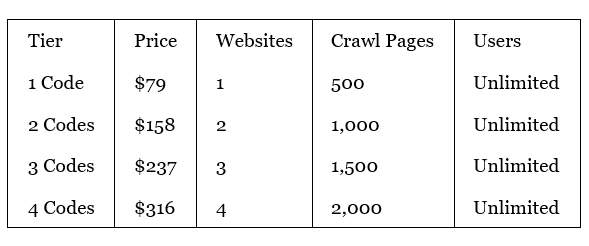
All tiers include: full technical and content SEO audit, rank tracking, Google Update report, Focus Keywords, low-hanging fruit, internal competition analysis, white-label reports, CSV/Word export, Google Analytics and GSC integration, Slack and Zapier integration, weekly email updates, structured data and OG tag analysis, and a timeline tracking all changes.
Flexible stacking: Codes can be split and merged. Four codes can be used as 1 site × 2,000 pages, 2 sites × 1,000 pages, or 4 sites × 500 pages. Minimum allocation is 500 pages per slot.
—
Regular Pricing (at time of writing, 09 March 2026)
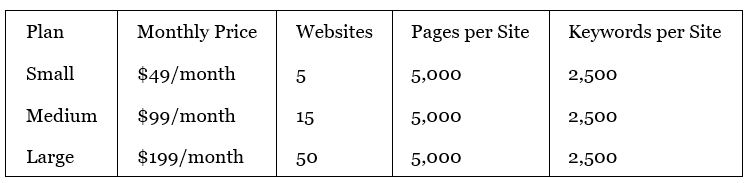
The AppSumo deal pays for itself in under two months compared to the Small plan. The trade-off is the 500-page-per-code limit versus 5,000 pages per site on regular plans.
Hidden costs and considerations
No per-crawl or per-page overage fees on AppSumo codes - the limit is hard-capped, not metered
No setup fees
Stacking beyond 4 codes (up to 10) is available on the AppSumo page for larger requirements
The AI Visibility Report and Traffic Acquisition report require Google Analytics - if your site does not use GA, these features are unavailable
Verify pricing on the vendor's website before purchasing.
—
Critical Risks
1. Page limit constraint (MEDIUM)
The AppSumo deal's 500-page-per-code limit is the most commonly cited limitation. For sites with 500+ pages, this requires purchasing multiple codes, which increases cost and management overhead. Mitigation: Plan your page allocation before purchasing. Use the flexible stacking system to optimise coverage across sites.
2. Key-person and team-size dependency (MEDIUM)
SiteGuru is operated by a three-person team. If the founder or a key team member becomes unavailable, product development, support, and infrastructure maintenance could be affected. Mitigation: This risk is inherent to all bootstrapped micro-SaaS products. The four-year track record (founded May 2022) and consistent product updates provide some confidence, but it is a material consideration for organisations building long-term workflows around the tool.
3. Google API dependency (MEDIUM)
Keyword insights, traffic data, and the new AI Visibility and Traffic Acquisition reports all depend on Google OAuth connections to Search Console and Analytics. Changes to Google's API terms, rate limits, or deprecation of endpoints would degrade these features. Mitigation: The core crawl-based audit features function independently. Maintain direct access to your GSC and GA accounts as a fallback.
4. No published uptime SLA (LOW)
No service-level agreement for uptime or crawl availability was found in SiteGuru's documentation. For agencies relying on SiteGuru for client deliverables, unplanned downtime could affect reporting timelines. Mitigation: Export reports as soon as they are generated. Do not rely exclusively on SiteGuru's live dashboard for client-facing work.
5. Limited compliance documentation (LOW)
SiteGuru's privacy policy, dated March 2020, covers basic data handling practices but does not reference GDPR by name, does not offer a Data Processing Agreement (DPA), and does not hold SOC 2 or ISO 27001 certifications. For governance-conscious organisations, this is a documentation gap rather than necessarily a security gap - the tool stores data in Ireland (EU jurisdiction) and encrypts data in transit and at rest.
Privacy & Data Handling
SiteGuru collects three categories of data: your email address (account management), Google OAuth tokens (read-only access to GSC and GA), and aggregated, anonymised crawl data for benchmarking purposes. The privacy policy explicitly states that email addresses are not used for marketing without consent, and Google account data is not shared with third parties.
Data residency: Ireland (EU jurisdiction), which means GDPR applies by default.
NZ Privacy Act consideration: Data is transferred to Ireland. Under the NZ Privacy Act 2020 (Information Privacy Principle 12), personal information may be disclosed to a foreign entity if the recipient is subject to privacy protections comparable to New Zealand law. EU/GDPR jurisdiction generally meets this threshold, but organisations should confirm this with their own legal advisors.
This review does not constitute legal or compliance advice. Consult your legal team before processing sensitive data.
—
Competitive Landscape
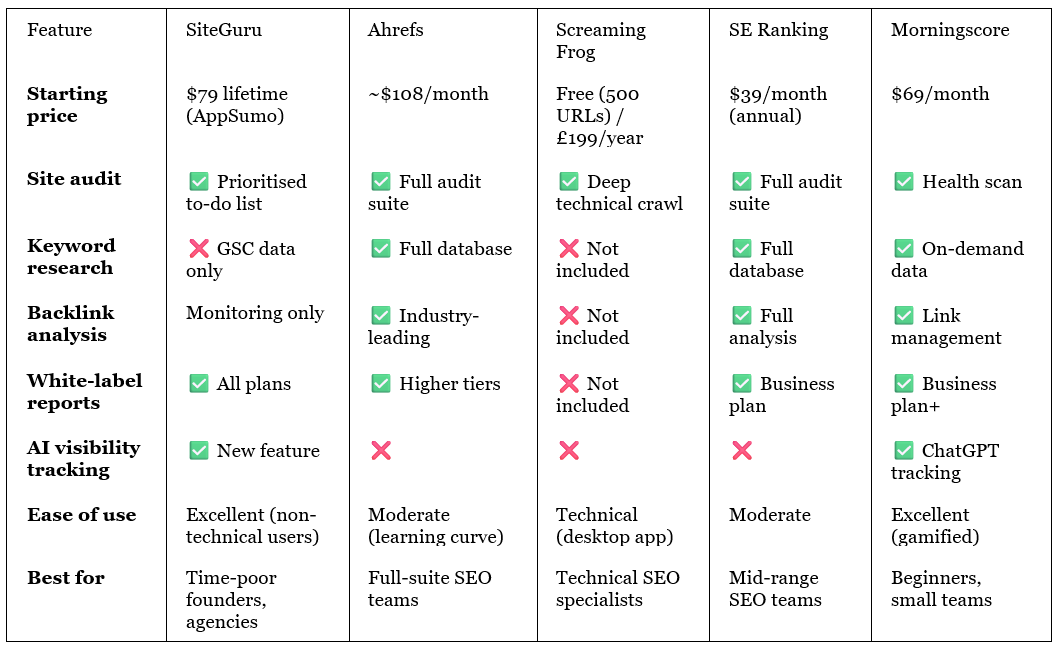
SiteGuru occupies the "accessible SEO audit" segment - more affordable and user-friendly than enterprise tools, but narrower in scope. It competes primarily on prioritisation, simplicity, and price.
Feature Comparison
When to choose SiteGuru vs alternatives
Choose SiteGuru if your primary need is a prioritised, actionable to-do list and you do not need keyword research or deep backlink analysis. The AppSumo lifetime deal makes it exceptionally cost-effective for micro-businesses and agencies managing multiple small sites.
Choose Ahrefs or Semrush if you need a full-suite SEO platform with keyword research databases, competitor analysis, content gap identification, and enterprise-grade backlink tools. These tools cost 10–20x more per year but offer significantly broader capability.
Choose Screaming Frog if you need deep technical crawling with full control over crawl settings, JavaScript rendering, and custom extraction. Screaming Frog runs locally (no cloud dependency) and is preferred by technical SEO specialists.
Choose SE Ranking if you need a mid-range platform with keyword research, site audit, and rank tracking at a lower price point than Ahrefs or Semrush. SE Ranking bridges the gap between SiteGuru's simplicity and enterprise tool complexity.
Choose Morningscore if you want a gamified SEO experience that assigns monetary value to your organic growth and includes AI visibility tracking. Morningscore's interface is designed for motivation and engagement rather than technical depth.
Market positioning
SiteGuru sits in the "accessible audit" tier - below enterprise platforms (Ahrefs, Semrush) and above basic plugins (Yoast). Its competitive advantage is not feature breadth but prioritisation clarity. The product assumes users do not want to become SEO experts; they want to know what to fix, in what order, and why it matters. With four years of iteration, 4,500 active users, and a 4.9 AppSumo rating, it has earned that position through consistent execution rather than feature proliferation.
—
Recommendation & Next Steps
Go/No-Go Decision Framework
✅ PROCEED IF
You run 1–5 websites and want a prioritised, weekly SEO to-do list
You are not an SEO specialist and want plain-language guidance
You need white-label reports for client delivery
Your sites are under 2,000 pages (or you are willing to stack codes)
You already use Google Search Console and/or Google Analytics
You value simplicity over feature depth
❌ HALT IF
Your primary site exceeds 5,000 pages (regular plan may be more cost-effective)
You need keyword research databases, competitor backlink analysis, or content gap tools
You require SOC 2 compliance, a DPA, or documented security certifications
You need real-time or on-demand crawling with configurable speed controls
Your budget supports a full-suite platform like Ahrefs or Semrush
Phased Implementation Roadmap
Phase 1 - Pilot (Week 1): Purchase one code ($79). Connect your primary site with GSC and GA. Run the first audit. Action the top 5 to-do items. Export a baseline report.
Phase 2 - Validate (Weeks 2–4): Monitor weekly email reports. Track GSC click-through rate and impression changes for pages you improved. Test the Google Update impact tracker. Evaluate whether the to-do list continues to surface meaningful improvements.
Phase 3 - Scale (Month 2+): If Phase 2 validates the tool, stack additional codes for secondary sites or client sites. Set up Zapier integrations to push to-do items into your project management tool. Begin using white-label reports for client delivery
—
Final Verdict
For founders and SMEs: SiteGuru is a genuine BUY. At $79 lifetime, it replaces manual SEO audits, gives you a clear weekly action list, and integrates with the Google tools you already use. The to-do list format is the difference between "I know I should do SEO" and "I know exactly what to fix this week." The four-year track record, 4.9 rating from 517 reviews, and EU data residency provide confidence for values-led organisations.
For agencies: SiteGuru is a BUY for agencies managing small-to-medium client sites. White-label reports, unlimited users, and flexible code stacking make it operationally viable. The to-do list format translates directly into client-facing deliverables. For agencies managing large enterprise sites (5,000+ pages), the regular plan or a full-suite tool like Ahrefs may be more appropriate.
If SiteGuru does not fit: Consider SE Ranking ($39/month annual) for a broader mid-range platform, or Screaming Frog (free for up to 500 URLs) for deep technical crawling. If budget allows, Ahrefs remains the industry standard for comprehensive SEO.
—
Ready to Implement This?
Start with the foundation: Get the Save 10 Hours a Week with AI (Small Business Quick Start) toolkit for $9.99 USD - a practical system for choosing and setting up AI tools like SiteGuru in your business.
If SiteGuru is right for you: Get the SiteGuru Lifetime Deal on AppSumo - $79 one-time for lifetime access, with a 60-day money-back guarantee.
Need guidance on your full SEO and AI stack? Book a $299 AI Systems Consult on the AI Ladder - your consult fee credits toward a full AI Health Check or Done-for-You implementation.
Ngā mihi nui and fa'afetai lava - may your business systems stay simple, safe, and sustainable.
Not sure where to start?
That is completely normal
The AI space can feel noisy when you are trying to decide between learning, planning, governance, implementation, and support.
The AI Ladder helps you choose the right next step based on your context, readiness, and capacity.
Start small. Prove value. Scale what works.